“An audit will bankrupt us”
Oregon law lets residents petition for an audit when they have accountability concerns. Fifty Rivergrove residents did. The Mayor tried to block it (without council approval) and failed. After the Mayor and City Manager then ignored our legal obligations for months, the State stepped in and took over the process, finally leading to compliance.
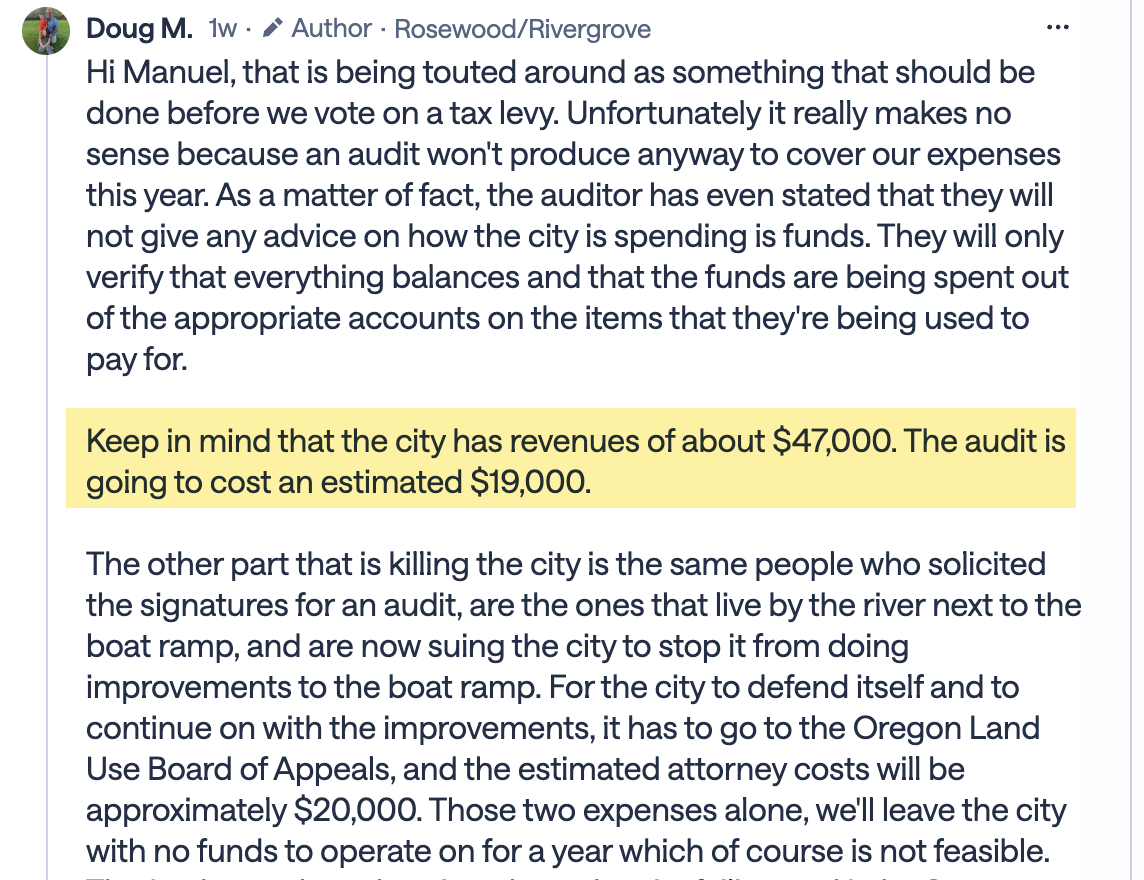 Screenshot via Nextdoor
Transcript of the screenshot—a Nextdoor reply from Doug M. (Author), Rosewood/Rivergrove:
Hi Manuel, that is being touted around as something that should be done before we vote on a tax levy. Unfortunately it really makes no sense because an audit won't produce anyway to cover our expenses this year. As a matter of fact, the auditor has even stated that they will not give any advice on how the city is spending is funds. They will only verify that everything balances and that the funds are being spent out of the appropriate accounts on the items that they're being used to pay for.
(Highlighted in the screenshot:) Keep in mind that the city has revenues of about $47,000. The audit is going to cost an estimated $19,000.
The other part that is killing the city is the same people who solicited the signatures for an audit, are the ones that live by the river next to the boat ramp, and are now suing the city to stop it from doing improvements to the boat ramp. For the city to defend itself and to continue on with the improvements, it has to go to the Oregon Land Use Board of Appeals, and the estimated attorney costs will be approximately $20,000. Those two expenses alone, we'll leave the city with no funds to operate on for a year which of course is not feasible.
The third major campaign claim was that the city couldn't afford the audit. That its cost alone would push Rivergrove toward insolvency.
This misleading framing inverts what actually happened. Residents pushed for the audit because, among other things, the Mayor and City Manager had been raising fees without showing the data to justify them, and had been building a weak but persistent case for a levy for months. The audit was a response to that spending, not a cause of it.
But leadership turned it around. The audit became just another expense (even as the Mayor repeatedly stated his authoritative opinion that the State couldn't make us pay what we'd owe them[1]), and the levy became the way to cover it. The accountability tool residents reached for was recast as a new cost that justified more of the spending it was meant to scrutinize.
This was a pattern, not a one-off. In April 2024, the council sharply raised development and tree fees: building-permit review fees went from $25 to $400, and the accessory-development permit went from $65 to $500, plus a slate of brand-new charges (Resolution 300-2024).
When I asked whether those numbers came from any analysis of actual costs, the Mayor acknowledged they did not.[2] When the Mayor's continued justification included that there had been applications "coming fast and furious", I asked how that could be, considering that the previous two Planning Commission meetings had been canceled because there hadn't been anything on the agenda. The Mayor said "fair point" and moved on without anyone addressing the obvious incoherence.
The records-fee overhaul a year later ran the same way. The text of the resolution itself justified it by referencing Rivergrove as a city that “has no tax base and limited resources” (Resolution 41425), with no real data provided. When Councilor Taylor pressed for the actual volume of records requests in a meeting[3], the City Manager couldn't provide it—despite having typed a hard number into an earlier packet[4]: 760 records requests from a single resident since 2018, a figure offered with no export, no documentation, and no proof to support it. Each time, the financial need was simply asserted, never shown.
Under ORS 297.445, a group of residents can petition to compel an independent audit. Thirty signatures is the threshold, and Rivergrove residents collected fifty. They wanted real answers about how the city's money was being managed, and they made it happen (kudos to everyone who did the work!).
The city resisted. The Mayor wrote to the Secretary of State asking them to throw out the petition. It was a letter he signed alone, but framed throughout as representing “the City of Rivergrove”.
For those who haven't recently reviewed the City Charter, Rivergrove has what's called a Weak Mayor System. In Weak Mayor Systems, the mayor has limited powers beyond ceremonially presiding over meetings, and all powers belong solely to the council.
The council never authorized this letter, and as per our Charter, “all powers of the city shall be vested in the council”. The mayor has no authority to act unilaterally on behalf of the city. While the state rejected the specious challenge, the Mayor acting unilaterally is another recurring problem (and the subject of another future post).
Inconsistent references to the timeframe do not invalidate the petitions. It’s clear the intent is an audit of the fiscal year ending June 30, 2025, as no other fiscal periods would apply. Further, the petition sheets 1, 2, and 9 through 12 indicate June 2025 or 2025 and contain 33 signatures. That would be sufficient to prompt the audit requirement even assuming the other sheets were, in fact, invalid.Steve Bergmann, Audits Director, Oregon Secretary of State, November 14, 2025
Following that failure, the Mayor and City Manager dragged their feet for months and months, despite numerous patient communications from the Secretary of State's office. Eventually, the state stepped in and forced compliance.
Mayor's letter to the Secretary of State
Asks the state to invalidate the petition over inconsistent fiscal-year labels on the signature sheets. Signed by the Mayor alone, presented as the City's position.
November 10, 2025 · Mayor Chris Barhyte (cc: City Manager)
Audit costs are one-time, not recurring. The campaign math compared estimated audit costs against the city's annual property tax revenue alone—a narrow denominator that omits the rest of the city's revenue streams (state shared revenue, franchise fees, grants, fines and fees). Against the full operating budget, the audit cost is a meaningful but manageable one-time expense.
The broader "heading for insolvency" framing assumes the city has no tools to manage budget pressure. In practice, council can adjust spending, services, and fees at any time—and the City Manager contract is the city's single largest line item. If the city's financial situation threatened insolvency, corrective action would start there. The campaign treated bankruptcy as imminent without addressing how to prevent it.
The right question isn't "how do we avoid the audit." It's "what will the audit tell us about how the city's money is being managed." That's the entire point of an audit. Residents asked the question; the audit is producing answers.
The Auditor's report was shared with the public on June 17. Just as predicted in an earlier meeting[5], it revealed significant lapses in internal controls—documented in detail in The Auditor Couldn't Sign Off on a Single Fund.
The Auditor's report
Details significant lapses in internal controls identified during the audit.
June 3, 2026 · City Council Meeting Agenda Packet, June 17, 2026