“We’ll be annexed by Lake Oswego”
There is nothing in the record that supports any link in that chain—and the Mayor conceded on the record that it was hearsay; no documentation was ever produced.
This was the centerpiece scare during the campaign. The version repeated in posts, emails, and yard-sign rebuttals went something like this: if the levy fails, the city will become insolvent, we will have to disincorporate, and then Lake Oswego will force-annex us. And something vague about sewers makes it extra true, so your choices are: vote to approve the levy, or get annexed.
There is no agreement or precedent that forces annexation. There is no legal precedent in the state of Oregon for anything even resembling this sort of action. The County Administrator, Lake Oswego City Manager, and Lake Oswego City Attorney's office all ended up at the same written answer.
Where the claim came from
This didn't start as campaign chatter. It came from senior city leadership—the City Manager and the Mayor—making specific probabilistic forecasts in official council meetings. Neither figure has a defensible source. When the Mayor was asked in the moment to provide one, he conceded the basis was hearsay.
City Manager, May 7, 2025 Budget Meeting
[02:26:31.4] Analeis Weidlich: I think it's about nine, 95% chance that we would not go back into the county. We would have to go to the city of Lake Oswego.
At the next regular council meeting, the Mayor repeated the claim with a different number and a different attribution—and was asked to substantiate it.
Mayor Barhyte, May 12, 2025 Council Meeting
[01:36:08] Chris Barhyte: Okay, so let me answer some of that. So first of all, uh, that was a misrepresentation of the facts. At the Budget Committee meeting, it was said this incorporation would be an option, but it looks like based on what we've heard, 85% chance we would probably be pushed due to some intergovernmental agreements and urban services to Lake Oswego. That was said—
[01:36:27] Leah Silber: Can we get a citation for that?
[01:36:30] Chris Barhyte: We heard it from our attorney and the previous mayor who looked at doing it, Fez.
[01:36:35] Leah Silber: No, I'm saying if it's 85%, that is very, very strong. You need to send the documentation showing that that's real, otherwise it's just hearsay.
[01:36:44] Chris Barhyte: Okay. All right. We'll say it's hearsay.
Attorneys do not produce probabilistic forecasts like this for unclear, unprecedented hypotheticals like ours. No documentation has been provided to support the claim, and no underlying analysis produces these numbers. The figure shifted by ten points between the two meetings, and the Mayor's own attribution didn't survive questioning—he conceded on the record within seconds that the basis was hearsay.
City leadership making and abandoning these percentages in real time is the strongest evidence the claim was constructed for the campaign, not grounded in any legal analysis.
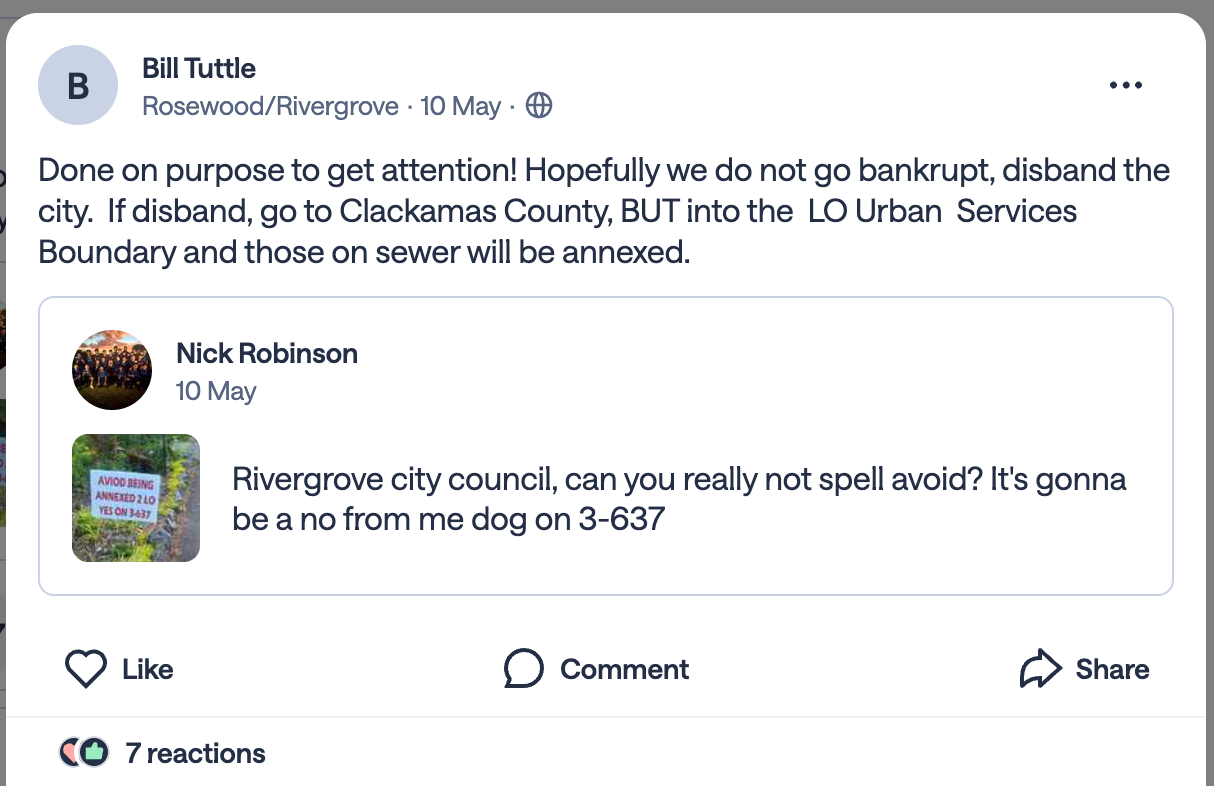 Screenshot via Nextdoor
This issue has come before and we have no such agreement, IGA or otherwise, with Rivergrove about disincorporation.Lake Oswego City Attorney's Office, December 29, 2025
Separately from the County and Lake Oswego correspondence, Councilor Curt Taylor produced an independent analysis of the disincorporation question in January 2026. The memo reached the same conclusion: disincorporation does not automatically annex a former city's territory to any neighbor. Annexation requires a separate statutory process under ORS Chapter 222.
Further, sewer service is legally distinct from annexation, even where (as in parts of Rivergrove) homes are connected to a Lake Oswego sewer line. The existing Lake Oswego sewer Zone of Benefit framework governs sewer service; annexation is governed separately and requires its own statutory process.
There is also no Oregon legal precedent for a disincorporated city being absorbed into a neighbor. The most recent comparable case (Damascus, 2016/2020) reverted to unincorporated Clackamas County status—exactly what the analysis describes.
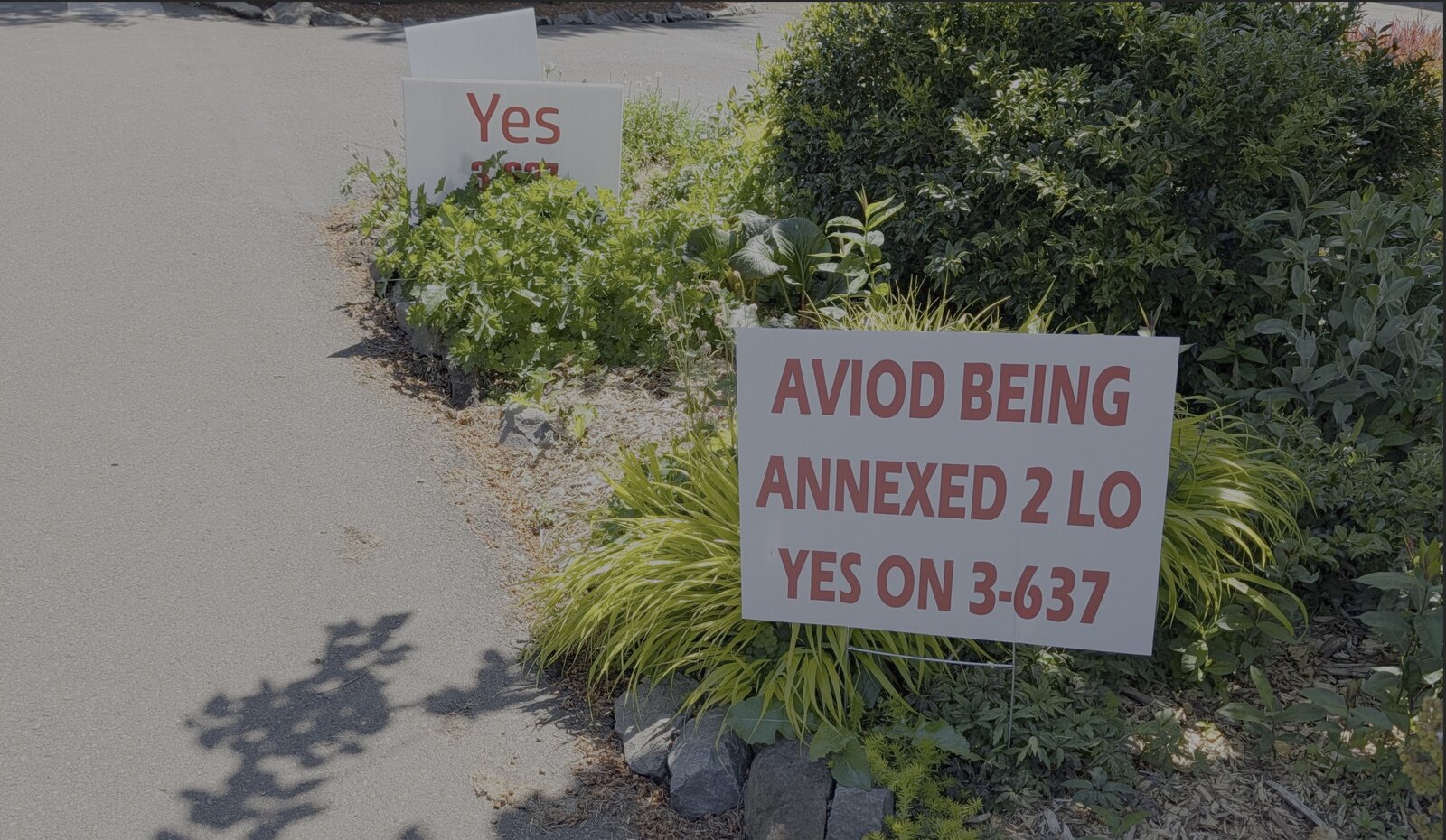
Taylor sent that memo to the full council the day it was discussed, and a resident emailed it to council again two days later. Both Councilor Tuttle and Councilor McLean were among the recipients—and both kept advancing the annexation claim through the campaign anyway: McLean in his own Nextdoor post, and Tuttle both in the Nextdoor post above and with several signs in prominent spots on his own property.
County and Lake Oswego email chain
December 29, 2025 – January 12, 2026 · source document
Internal council memo: disincorporation and sewer service
January 11, 2026 · legal analysis
"But the lawyer said so!"
Separately from the in-meeting claims by city leadership and the signs posted outside the homes of councilors, the campaign also leaned on a single email from the City Attorney, forwarded by the City Manager to other councilors and distributed in meeting minute packets as “proof”. The email was repeatedly cited during the campaign as authoritative legal confirmation that annexation would follow disincorporation. The opening words of the attorney's substantive comment were:
Further, although I have not seen the Lake Oswego consent to annexation form, in general, these contracts allow the city to force annexation at any time so the owner has no control over the circumstances in which this happens.Carrie Richter, City Attorney email, January 12, 2026
That is hedged commentary from an attorney who explicitly had not reviewed the relevant document, framed as a general observation about a category of contracts she hadn't seen the Rivergrove version of. During the campaign, it was repeatedly presented as a definitive forecast of what would happen if the measure failed. It was not.
City Attorney email forwarded to councilors
The City Attorney's email containing the hedged commentary that was repeatedly cited during the campaign as a definitive forecast of post-disincorporation annexation.
January 12, 2026 · forwarded by the City Manager
So what's the situation, really?
There has been zero communication made public from anyone in Lake Oswego government—official or unofficial—indicating any actual interest in annexing Rivergrove. Not at council meetings, not in correspondence, not in any public forum. The chain of hypotheticals required for annexation to actually happen (a "consent to annexation" agreement actually existing → insolvency → disincorporation → Lake Oswego choosing to annex → annexation succeeding under Oregon law) has no link in it that's currently active.
All this also assumes the city would take no action to prevent insolvency in the first place—no spending cuts, no service reductions, no other corrective measures—when in practice council action could prevent any of the early links from materializing.
Treating annexation as imminent during the campaign was fear-based campaigning, and the evidence never supported it. It's also worth being clear about what the levy the scare was pushing would have funded. The City Manager prepared and presented the levy analysis, and the budget written to spend that money would have raised her own contract from $52,500 to $70,000—a $17,500 increase, roughly 29% of the $60,500 in levy revenue the city itself projected. (Her own first draft of the budget had asked for $72,000.) That allocation is on the face of the budget the Budget Committee recommended to the Council. Voters rejected the levy on May 19. The revised no-levy budget the Council approved on June 8 and formally adopted by resolution on June 17 nonetheless still raised the City Manager's contract, from $52,500 to $57,500. The fuller accounting is a separate post to come.
Postscript, June 2026: The measure failed, and the chain's first link promptly failed with it. In the June 8 deliberation over that no-levy budget, asked whether the city could stay solvent and meet its obligations without the levy, the Mayor's answer was "we're super tight, it's a cash flow issue a little bit"—and the main obligation he identified as unfunded anywhere in the discussion was the roughly $20,000 state-audit bill, toward which the Council chose to budget $1,000. No insolvency. No disincorporation. No annexation.